Thursday, 24 March 2016

Brief history of the Telescopes

 Yeah guys do you know the story of the telescopes?
 It all started with........, galileo? Oh he was not the inventor as many of us know.
But it all started with Hans Lippershey,he was a spectacle maker from germany here in short about them
Hans Lippershey
Lipperhey portrait.jpg
Born1570
WeselDuchy of ClevesGermany
DiedSeptember 1619 (aged 48–49)
MiddelburgNetherlands
NationalityGermanDutch
Occupationspectacle-maker
Known forInventor of the telescope(earliest known patent application) ,via wikipedia.org
know more
Okay then let us get back to the story of the telescopes though it is unclear if lippershey was the inventor, it was a great thing to be invented , it started with refracting telescopes then came galileo the problem of the then existing telescopes is that the astronomical telescope was that the magnified images though clear was inverted, so galileo  improved the version the astronomical and it was called the galilean telescope, the speciality of this was that instead of only using convex  mirror, galileo built one which had a concave mirror which made the images erect . but still there was a disadvantage in the telescopes was the chromatic aberration (a rainbow seen around some objects viewed with a refractor telescope).
Optical diagram of Galilean telescope
Then it was The Keplerian telescope, invented by Johannes Kepler in 1611, is an improvement on Galileo's design.It uses a convex lens as the eyepiece instead of Galileo's concave one. The advantage of this arrangement is that the rays of light emerging from the eyepiece are converging.

 Optical diagram of Keplerian telescope
ThGregorian telescope, described by Scottish astronomer and mathematician James Gregory in his 1663 book Optica Promota, employs a concave secondary mirror that reflects the image back through a hole in the primary mirror. This produces an upright image, useful for terrestrial observations. Some small spotting scopes are still built this way.
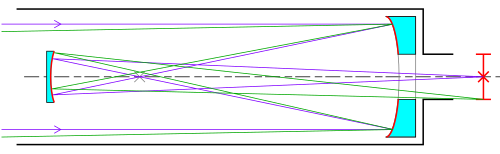
Light path in a Gregorian telescope.

 Then it was Isaac Newton who came up with the reflecting telescope model which did not suffer from chromatic aberration. 
  newtonian reflector telescopes use two mirrors instead of two lenses, one of them is a paraboloidal mirror.
But then even the reflector had  a problem-coma. it is an inherent property of telescopes using parabolic mirrors. Unlike a spherical mirror, a bundle of parallel rays parallel to the optical axis will be perfectly focused to a point (the mirror is free of spherical aberration), no matter where they strike the mirror.
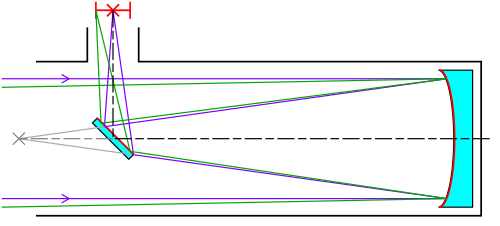
Light path in a Newtonian telescope


But in the recent times there has been a combined use of both the types lately that is 
Schmidt Cassegrain telescopes it did not suffer from the chromatic aberration or  
 comatic aberration. But you know every telescopes has its own pros and cons the Cassegrain telescopes are a bit costly. 
The Cassegrain telescope (sometimes called the "Classic Cassegrain") was first published in an 1672 design attributed to Laurent Cassegrain. It has a parabolic primary mirror, and a hyperbolic secondary mirror that reflects the light back down through a hole in the primary. Folding and diverging effect of the secondary creates a telescope with a long focal length while having a short tube length
there are ways to correct both the aberrations. in refractor it is the achromatic lenses and for reflector's it is rowe-coma-corrector
  After this there was n number of telescopes invented to know more about the comos x-ray telescopes and others.

Light path in a Cassegrain telescope
Light path in a Cassegrain reflecting telescope


know more about optical aberration
 about the whole history of the telescopes, here

Hey guys do comment and like :) !!

Wednesday, 23 March 2016

Parallel universe

HI guys sorry  that i could not catch up lately but then let me get back to my article.
 Parallel universe! though this sounds like fiction it need not necessarily be one.
 There is a lot of hypothesis on parallel universe one thing is that it necessarily looks the same this hyp. needn't be true for the fact that the beings living may be the same but they need not be of the same kind.
  Parallel universe needs the multiple universe hyp. to be true. For the fact that we dont know how many of them are out there.
 Parallel universe hyp. may even help us understanding the string theory that is two things in the same place(i mean if we are successful in travelling through the barrier in space) and are the same. Then travelling through universe will be more complicated than travelling through time of course.
Okay then as we don't know much of the parallel universe we look forward to some person finding it.
There are a lot of stories written and a lot of tv series relating to parallel universe.
The one which i know and i liked is the flash.

we can use wormhole to travel through the parallel universes as it connects any two places possibly even any part of  spacetime
#Scientists May Have Just Discovered a #ParallelUniverse Leaking Into Ours. We may have just, for the first time ever, caught a tantalizing glimpse of a parallel universe bumping against our own. Scientists say that signals from the furthest reaches of space suggest that the fabric of our universe is being disrupted by another universe. The discovery could provide proof of the #multiverse theory, which says that there are many alternate universes. READ MORE of this #4biddenknowledge  http://...:
credit instagram
Know more
there is a link on sciencealert.com in which you wll find a person is claiming he has found parallel universe

Hey guys don't forget to comment and like :) !!

Saturday, 13 February 2016

Listening to the space-time ripples

What was predicted by Einstein 100 years ago has now after a close study has been proved. Back then in the 20th century we were literally in utter darkness when it came about that part of relativity which seemed back then like fiction I mean the space-time
ripples caused by gravitational waves. This was first detected in 2015 Sept 14th at LIGO(the international gravitational-wave Observatory), but they had to keep us in darkness  until they did a complete study of what had caused it.
the jolt of the gravitational wave was caused when two black holes had gone through the the process of collision, Ring down and this created it.
credit deccan herald.com
 then it was observed in LIgo underground observatory which is 1900 miles apart.


 via LIGO.org
more on space.com
Hey guys do comment and like :) !!

Monday, 25 January 2016

Rumor of trip to mars in 70 days

Yes it is quite shocking . But the Nasa scientists seem to have designed a engine has they named electromagnetic propulsion drive. They said that they had tested it is a vacuum that replicates space.
It is safe to be quiet and not  get excited because that engine seems to violate the basic law of momentum . It may be that the whole  news is a hoax, but i do see some shut doors which are yet to open and we might already have the key to open it. So i would look forward to such an invention as it would for sure create a world wide transformation of course.
We should be in the shadows until NASA sheds some light on this subject.

                                   
source: science alert
via :sciencealert.com, read the full article here
Hey guys comment and like :) !!

Sunday, 24 January 2016

Diary events of '15!!

Sorry guys this was a bit too late but still i felt it is worthwhile posting. Anyway back to the topic.
1>In 2015 a cousin of earth was found, that is the discovery of the exoplanet Kepler- 452b in or around July. It was found lurking in the skies in the constellation of Cygnus located 1400 light years away.
our mother's quite old cousin
                             Now I know where I come from ❤️ #kepler452b:

2> We detected cosmic neutrinos, ultra high energy particles that travelled from the milky way and beyond. Being created by black holes and other exploding stars they cannot be detected because they have no mass or charged. Ice cube neutrino observatory in Antarctica identified particles muons which are created when neutrinos interact with other particles.
3> At last Indian MOM mission had successfully completed its mission objective that is to orbit mars. The credit goes to ISRO and others who helped receive the first message from mom. India was one of the countries to be successful in its first attempt in a very low budget.
Congrats to #India's space program on their successful #MarsOrbiterMission #ISRO #NASA #space #mars #universe #physics #astrophysics #engineering #itsnotrocketscience #ohwaityesitis #cosmos #Namaste:  #gravity#movie#budget#mangalyan#India#mars#proud#to#be#an #indian:
#mangalyan #ISRO #makingindiaproud #graVITasUnleashed #graVITas15 #design #create #patent #vituniversity:

4> Water on mars !! It was a very sensational moment which i still remember. It was quite an awesome thing to find water in our closest neighbourhood. I will make this part short as i have already written about in us may visit that page here.....Nasa's Mars Reconnaissance Orbiter picked an image showing lineage and dark streaking, hint of moist soil. This increased the hope to find life on mars! 
5> IT was 100 years since einstein!! to commemorate the 100th anniversary of his great theory of relativity , scientists developed a new method to test one of the basic principles of relativity called fast radio bursts, which used radio waves which was n times better than the previous method that used gamma ray bursts.
6> LHC back to life !! Lhc resumed its colliding business in april after 2 years of repairs and upgrades and now it has double the speed of its first run . Soon in July LHC discovered a new kind of particle called pentaquark.This particle consists of four quarks and one anti-quark.


HOped you guys liked it ; )
Hey guys do comment and like :) !!

Sunday, 10 January 2016

Faster than light?

 Yeah there is a theoretical particle that may travel faster than light. You may have heard of these in many places, like the involvement of tachyons in the speed force of Flash.
Anyway if those particles were to exist in reality it could be used for interstellar communication which would help us to communicate(send signals faster) faster than the speed of light, but this is not supported by relativity as it says that no particle travels faster than light. Either way it is possible. If there is a tachyon like particle existing, it would for sure bring a lot of change in physics and help us to built a lot of new techs and also give us a key to time travel.
Another thing as a tachyon moves faster than the speed of light, we cannot see them but when it passes by we will see two images , one appearing and other departing in opposite directions. There are many sorts locked yet and we might already have key to open the doors.  

                       Alt text

via wikipedia 
 
Hey guys do comment and like :) !!

Sunday, 22 November 2015

How do you get to know the Composition of faraway objects????????

  We all read day to day news, scientists tell that so and so planet is made off....... A question arises in our mind that how do they find out or come to know sitting right on earth, of course spacecrafts can't go to galaxies which are millions of light years away.
  The composition of every object is written in the light that bounces or more precisely gets reflected from the object's surface . Written in the spectrum is the composition of the object . Amazed!?
  Yes when the light hits an object the electrons of the atoms present in the object absorbs some energy casting a black line in the spectrum. these black lines are called Fraunhofer lines named after Joseph von Fraunhofer, who was the inventor the spectroscope. 
   The spectroscope is the combination of prism and a telescope. Prism as it splits the light into its spectrum and telescope because it zooms through the spectrum.
 The order of the back lines is different for different elements as the arrangement of the electron is different in different elements. 
 So thanks to Fraunhofer who has helped us look beyond our reach.
Fraunhofer demonstrating the spectroscope.
Read more on Joseph von Fraunhofer, here
Spectroscope has helped us to not only know about stars and planets but , also galaxies which are totally out of our reach.
Solar spectrum with Fraunhofer lines as it appears visually.
know more on Fraunhofer lines, here
Please +1 and comment if you liked this post

Mars' Moon is falling apart!?!?!?!?!

   Phobos has a structural failure and is likely to fall apart in another 30-50 million years.
Orbiting a mere 3,700 miles (6,000 kilometers) above the surface of Mars, Phobos is closer to its planet than any other moon in the solar system. Mars’ gravity is drawing in Phobos, the larger of its two moons, by about 6.6 feet (2 meters) every hundred years.
phobos moon in color
New modeling indicates that the grooves on Mars’ moon Phobos could be produced by tidal forces – the mutual gravitational pull of the planet and the moon. Initially, scientists had thought the grooves were created by the massive impact that made Stickney crater (lower right).
Credits: NASA/JPL-Caltech/University of Arizona

via-nasa.gov


Please +1 and comment if you liked this post

Saturday, 26 September 2015

Life cycle of a star?!?!!?!?

 
     This is an image of a stellar nursery, from these cold clouds of stellar matter protostar form as they collapse under gravitational disturbances.that is it will stay the same until the kinetic energy is balanced with
the potential energy of the internal gravitational field.
     when these protostars start to collapse and the pressure and temperature the cloud, it starts to form a disc
and nuclear reactions start to take place.
  At this point some protostars are rather too small and don't achieve nuclear reactions and are called failed stars or brown dwarfs.
  All the other protostars which have achieved nuclear reactions show very unstable behaviour like rapid rotation strong wind and eject a lot of nuclear materials at the poles and slowly stabilise.
  In stars have more than about 0.08 solar masses form a star having nuclear reactions. The core of the stars literally start collecting the stellar clouds during this time some of the hot nuclear substance fly off to form planets which individually start collecting the stellar clouds around them. After this formation of stars and planets, the stars , enter the main sequence, every star spends about 90% of their life in this stage.

  •  Stars lesser than 1 solar mass collapse to form a dim black dwarf.
  •  Sun like stars (1solar mass) evolve or more precisely get swollen to form a red giant, the outer layers  form the planetary nebulae the heavy elements now help the core to become a white dwarf  which will  be inside the planetary nebulae.
  • Stars having more than 8 solar masses evolve in a super giant, explodes as a supernova, smaller  remnants become neutron star or stars that are of almost the size of earth and larger remnants become a black 
          know more on black holes
       Here is a video from nasa.gov ,


Please do +1 G and comment if you liked this post 

Friday, 25 September 2015

Newly Discovered Supermassive Black Hole --"Defies Theories of Galaxy-Size Limits"

Maxresdefault

The central supermassive black hole of a recently discovered galaxy is far larger than should be possible, according to current theories of galactic evolution. New work, carried out by astronomers at Keele University and the University of Central Lancashire, shows that the black hole is much more massive than it should be, compared to the mass of the galaxy around it. The scientists publish their results in a paper in Monthly Notices of the Royal Astronomical Society.

The galaxy, SAGE0536AGN, was initially discovered with NASA's Spitzer space telescope in infrared light. Thought to be at least 9 billion years old, it contains an active galactic nucleus (AGN), an incredibly bright object resulting from the accretion of gas by a central supermassive black hole. The gas is accelerated to high velocities due to the black hole's immense gravitational field, causing this gas to emit light.
The team has now also confirmed the presence of the black hole by measuring the speed of the gas moving around it. Using the Southern African Large Telescope, the scientists observed that an emission line of hydrogen in the galaxy spectrum (where light is dispersed into its different colours – a similar effect is seen using a prism) is broadened through the Doppler Effect, where the wavelength (colour) of light from objects is blue- or red-shifted depending on whether they are moving towards or away from us. The degree of broadening implies that the gas is moving around at high speed, a result of the strong gravitational field of the black hole.

Sunday, 6 September 2015

Is this the most distant object ever discovered??????

98727_web

In search of objects from the early universe,a team of Caltech researchers after many years of research have found some things which could be the most distant galaxy.In an article published August 28, 2015 in Astrophysical Journal Letters, Adi Zitrin, a NASA Hubble Postdoctoral Scholar in Astronomy, and Richard Ellis--who recently retired after 15 years on the Caltech faculty and is now a professor of astrophysics at University College, London--describe evidence for a galaxy called EGS8p7 that is more than 13.2 billion years old. The universe itself is about 13.8 billion years old.Earlier this year, EGS8p7 had been identified as a candidate for further investigation based on data gathered by NASA's Hubble Space Telescope and the Spitzer Space Telescope. Using the multi-object spectrometer for infrared exploration (MOSFIRE) at the W.M. Keck Observatory in Hawaii, the researchers performed a spectrographic analysis of the galaxy to determine its redshift. Redshift results from the Doppler effect, the same phenomenon that causes the siren on a fire truck to drop in pitch as the truck passes. With celestial objects, however, it is light that is being "stretched" rather than sound; instead of an audible drop in tone, there is a shift from the actual color to redder wavelengths.
Redshift is traditionally used to measure distance to galaxies, but is difficult to determine when looking at the universe's most distant--and thus earliest--objects. Immediately after the Big Bang, the universe was a soup of charged particles--electrons and protons--and light (photons). Because these photons were scattered by free electrons, the early universe could not transmit light. By 380,000 years after the Big Bang, the universe had cooled enough for free electrons and protons to combine into neutral hydrogen atoms that filled the universe, allowing light to travel through the cosmos. Then, when the universe was just a half-billion to a billion years old, the first galaxies turned on and reionized the neutral gas. The universe remains ionized today.
Prior to reionization, however, clouds of neutral hydrogen atoms would have absorbed certain radiation emitted by young, newly forming galaxies--including the so-called Lyman-alpha line, the spectral signature of hot hydrogen gas that has been heated by ultraviolet emission from new stars, and a commonly used indicator of star formation.
Because of this absorption, it should not, in theory, have been possible to observe a Lyman-alpha line from EGS8p7.
A graphic representation below of the extreme distance of galaxy EGS8p7. To the far right is theW. M. Keck telescope used for the observation, to the far left is the Big Bang, and at the center is the galaxy. The scale above indicates the progression of ever more distant discoveries and the corresponding year, and at the bottom is a time scale equivalent to distance. Finally, the inset to top left charts the observations made across two nights with the MOSFIRE spectrometer that resulted in the detection. (Adi Zitrin/ Caltech).
Please +1 and comment if you liked this post and if there is any doubt or any corrections
via:dailygalaxy.com

Sunday, 30 August 2015

Hubble Sees a Youthful Cluster

Dense collection of stars

Shown here in a new image taken with the Advanced Camera for Surveys (ACS) on board the NASA/ESA Hubble Space Telescope is the globular cluster NGC 1783. This is one of the biggest globular clusters in the Large Magellanic Cloud, a satellite galaxy of our own galaxy, the Milky Way, in the southern hemisphere constellation of Dorado.
First observed by John Herschel in 1835, NGC 1783 is nearly 160,000 light-years from Earth, and has a mass around 170,000 times that of the sun.
Globular clusters are dense collections of stars held together by their own gravity, which orbit around galaxies like satellites. The image clearly shows the symmetrical shape of NGC 1783 and the concentration of stars towards the center, both typical features of globular clusters.
By measuring the color and brightness of individual stars, astronomers can deduce an overall age for a cluster and a picture of its star formation history. NGC 1783 is thought to be less than one and a half billion years old — which is very young for globular clusters, which are typically several billion years old. During that time, it is thought to have undergone at least two periods of star formation, separated by 50 to 100 million years.
This ebb and flow of star-forming activity is an indicator of how much gas is available for star formation at any one time. When the most massive stars created in the first burst of formation explode as supernovae they blow away the gas needed to form further stars, but the gas reservoir can later be replenished by less massive stars which last longer and shed their gas less violently. After this gas flows to the dense central regions of the star cluster, a second phase of star formation can take place and once again the short-lived massive stars blow away any leftover gas. This cycle can continue a few times, at which time the remaining gas reservoir is thought to be too small to form any new stars.
Image credit: ESA/Hubble & NASA,  Acknowledgement: Judy Schmidt
Text credit: European Space Agency
Please comment and +1  any corrections and if you liked it too
 VIA: NASA.GOV

Saturday, 29 August 2015

Cosmic Collision Triggers Rebirth of Phoenix


Astronomers have found evidence for a faded electron cloud "coming back to life," much like the mythical phoenix, after two galaxy clusters collided. This "radio phoenix," so-called because the high-energy electrons radiate primarily at radio frequencies, is found in Abell 1033. The system is located about 1.6 billion light years from Earth.

By combining data from NASA's Chandra X-ray Observatory, the Westerbork Synthesis Radio Telescope in the Netherlands, NSF's Karl Jansky Very Large Array (VLA), and the Sloan Digital Sky Survey (SDSS), astronomers were able to recreate the scientific narrative behind this intriguing cosmic story of the radio phoenix.
Galaxy clusters are the largest structures in the Universe held together by gravity. They consist of hundreds or even thousands of individual galaxies, unseen dark matter, and huge reservoirs of hot gas that glow in X-ray light. Understanding how clusters grow is critical to tracking how the Universe itself evolves over time.

Astronomers think that the supermassive black hole close to the center of Abell 1033 erupted in the past. Streams of high-energy electrons filled a region hundreds of thousands of light years across and produced a cloud of bright radio emission. This cloud faded over a period of millions of years as the electrons lost energy and the cloud expanded.

The radio phoenix emerged when another cluster of galaxies slammed into the original cluster, sending shock waves through the system. These shock waves, similar to sonic booms produced by supersonic jets, passed through the dormant cloud of electrons. The shock waves compressed the cloud and re-energized the electrons, which caused the cloud to once again shine at radio frequencies.

A new portrait of this radio phoenix is captured in this multi wavelength image of Abell 1033. X-rays from Chandra are in pink and radio data from the VLA are colored green. The background image shows optical observations from the SDSS. A map of the density of galaxies, made from the analysis of optical data, is seen in blue. Mouse over the image above to see the location of the radio phoenix.

The Chandra data show hot gas in the clusters, which seems to have been disturbed during the same collision that caused the re-ignition of radio emission in the system. The peak of the X-ray emission is seen to the south (bottom) of the cluster, perhaps because the dense core of gas in the south is being stripped away by surrounding gas as it moves. The cluster in the north may not have entered the collision with a dense core, or perhaps its core was significantly disrupted during the merger. On the left side of the image, a so-called wide-angle tail radio galaxy shines in the radio. The lobes of plasma ejected by the supermassive black hole in its center are bent by the interaction with the cluster gas as the galaxy moves through it.

Astronomers think they are seeing the radio phoenix soon after it had reborn, since these sources fade very quickly when located close to the center of the cluster, as this one is in Abell 1033. Because of the intense density, pressure, and magnetic fields near the center of Abell 1033, a radio phoenix is only expected to last a few tens of millions of years.
Please comment and +1  any corrections and if you liked it too

The neighbouring quasar which is literally home for a binary pair of supermassive blackholes


Astrophysicists have found two supermassive black holes in Markarian 231, the nearest quasar to Earth, using observations from NASA's Hubble Space Telescope. The discovery of two supermassive black holes--one larger one and a second, smaller one--are evidence of a binary black hole and suggests that supermassive black holes assemble their masses through violent mergers.
Xinyu Dai of Oklahoma University , collaborated on this project with Youjun Lu of the National Astronomical Observatories of China, Chinese Academy of Sciences. Dai and Lu looked at ultraviolet radiation emitted from the center of the Mrk 231 from Hubble observations, then applied a model developed by Lu to the spectrum of the galaxy. As a result, they were able to predict the existence of the binary black holes in Mrk 231.
"We are extremely excited about this finding because it not only shows the existence of a close binary black hole in Mrk 231, but also paves a new way to systematically search binary black holes via the nature of their ultraviolet light emission," said Lu, National Astronomical Observatories of China, Chinese Academy of Sciences.
"The structure of our universe, such as those giant galaxies and clusters of galaxies, grows by merging smaller systems into larger ones, and binary black holes are natural consequences of these mergers of galaxies," said Dai.
So over time, the two black holes discovered by Dai and Lu in Mrk 231 will collide and merge to form a quasar with a supermassive black hole. A quasar is an active galaxy with an illuminated center, which is short lived compared to the age of the universe.
The results of this project were published in the August 14, 2015, edition of The Astrophysical Journal.
via  University of Oklahoma
Image Credit: Space Telescope Science Institute, Baltimore, Maryland
Please comment and +1  any corrections and if you liked it too

Are matter and antimatter mirror images of each other?

   Matter and antimatter look almost like they both are mirror images.The biggest difference between them is that they are made of subatomic particles which have opposite charge.That is electron and positron or anti electron, proton and anti proton & neutron  and antineutron.
 Another mystery is that though neutrons are different from anti neutrons, they are both neutrally charged. Both of them are made of quarks that possess fractional electrical charges, and the charges of these quarks are equal and opposite to one another in neutrons and antineutrons.
The known universe is composed of everyday matter. Another more profound mystery is, why the universe is not made up of equal parts antimatter, since the Big Bang that is thought to have created the universe 13.7 billion years ago produced equal amounts of both. And if matter and antimatter appear to be mirror images of each other in every respect save their electrical charge, there might not be much any of either type of matter left — matter and antimatter annihilate when they encounter each other. [The 9 Biggest Unsolved Mysteries in Physics]
A newly reported experiment involving matter and antimatter was carried out in CERN's Antiproton Decelerator.CREDIT: N. Kuroda
via:space.com
Please do comment if there is any corrections and like you liked this post

Sunday, 23 August 2015

theory of general relativity

Theory of General Relativity
Einstein's theory of general relativity predicted that the space-time around Earth would be not only warped but also twisted by the planet's rotation. Gravity Probe B showed this to be correct.
Credit: NASA In 1905, Albert Einstein determined that the laws of physics are the same for all non-accelerating observers, and that the speed of light in a vacuum was independent of the motion of all observers. This was the theory of special relativity. It introduced a new framework for all of physics and proposed new concepts of space and time.
Einstein then spent 10 years trying to include acceleration in the theory and published his theory of general relativity in 1915. In it, he determined that massive objects cause a distortion in space-time, which is felt as gravity.

The tug of gravity

Two objects exert a force of attraction on one another known as "gravity." Sir Isaac Newton quantified the gravity between two objects when he formulated his three laws of motion. The force tugging between two bodies depends on how massive each one is and how far apart the two lie. Even as the center of the Earth is pulling you toward it (keeping you firmly lodged on the ground), your center of mass is pulling back at the Earth. But the more massive body barely feels the tug from you, while with your much smaller mass you find yourself firmly rooted thanks to that same force. Yet Newton's laws assume that gravity is an innate force of an object that can act over a distance.
Albert Einstein, in his theory of special relativity, determined that the laws of physics are the same for all non-accelerating observers, and he showed that the speed of light within a vacuum is the same no matter the speed at which an observer travels. As a result, he found that space and time were interwoven into a single continuum known as space-time. Events that occur at the same time for one observer could occur at different times for another.
As he worked out the equations for his general theory of relativity, Einstein realized that massive objects caused a distortion in space-time. Imagine setting a large body in the center of a trampoline. The body would press down into the fabric, causing it to dimple. A marble rolled around the edge would spiral inward toward the body, pulled in much the same way that the gravity of a planet pulls at rocks in space. [Video: How To See Spacetime Stretch]

Experimental evidence

Although instruments can neither see nor measure space-time, several of the phenomena predicted by its warping have been confirmed.
Einstein's Cross
Einstein's Cross is an example of gravitational lensing.
Credit: NASA and European Space Agency (ESA)

Gravitational lensing: Light around a massive object, such as a black hole, is bent, causing it to act as a lens for the things that lie behind it. Astronomers routinely use this method to study stars and galaxies behind massive objects.
Einstein's Cross, a quasar in the Pegasus constellation, is an excellent example of gravitational lensing. The quasar is about 8 billion light-years from Earth, and sits behind a galaxy that is 400 million light-years away. Four images of the quasar appear around the galaxy because the intense gravity of the galaxy bends the light coming from the quasar.
Gravitational lensing can allow scientists to see some pretty cool things, but until recently, what they spotted around the lens has remained fairly static. However, since the light traveling around the lens takes a different path, each traveling over a different amount of time, scientists were able to observe a supernova occur four different times as it was magnified by a massive galaxy.
In another interesting observation, NASA's Kepler telescope spotted a dead star, known as a white dwarf, orbiting a red dwarf in a binary system. Although the white dwarf is more massive, it has a far smaller radius than its companion.
"The technique is equivalent to spotting a flea on a light bulb 3,000 miles away, roughly the distance from Los Angeles to New York City," Avi Shporer of the California Institute of Technology said in a statement.
Changes in the orbit of Mercury: The orbit of Mercury is shifting very gradually over time, due to the curvature of space-time around the massive sun. In a few billion years, it could even collide with Earth.
Frame-dragging of space-time around rotating bodies: The spin of a heavy object, such as Earth, should twist and distort the space-time around it. In 2004, NASA launched the Gravity Probe B (GP-B). The precisely calibrated satellite caused the axes of gyroscopes inside to drift very slightly over time, a result that coincided with Einstein's theory.
"Imagine the Earth as if it were immersed in honey," Gravity Probe-B principal investigator Francis Everitt, of Stanford University, said in a statement.
"As the planet rotates, the honey around it would swirl, and it's the same with space and time. GP-B confirmed two of the most profound predictions of Einstein's universe, having far-reaching implications across astrophysics research."
Gravitational redshift: The electromagnetic radiation of an object is stretched out slightly inside a gravitational field. Think of the sound waves that emanate from a siren on an emergency vehicle; as the vehicle moves toward an observer, sound waves are compressed, but as it moves away, they are stretched out, or redshifted. Known as the Doppler Effect, the same phenomena occurs with waves of light at all frequencies. In 1959, two physicists, Robert Pound and Glen Rebka, shot gamma-rays of radioactive iron up the side of a tower at Harvard University and found them to be minutely less than their natural frequency due to distortions caused by gravity.
Gravitational waves: Violent events, such as the collision of two black holes, are thought to be able to create ripples in space-time known as gravitational waves. The Laser Interferometer Gravitational Wave Observatory (LIGO) is currently searching for the first signs of these tell-tale indicators.
In 2014, scientists announced that they had detected gravitational waves left over from the Big Bang using the Background Imaging of Cosmic Extragalactic Polarization (BICEP2) telescope in Antarctica. Such waves are thought to be embedded in the cosmic microwave background. However, further research revealed that their data was contaminated by dust in the line of sight.
"Searching for this unique record of the very early universe is as difficult as it is exciting," Jan Tauber, the European Space Agency's project scientist for the Planck space mission to search for cosmic waves, said in a statement.
12 things to know about Einstein's theories of relativity


 I f you liked this post please do comment....do suggest suggestions or corrections if any :)

read more: on wikipedia


Saturday, 22 August 2015

Could dark energy be a 5th hidden force after time?!?!?!!??????????????


6a00d8341bf7f753ef01a3fce06a48970b


Dark energy is hiding in our midst in the form of hypothetical particles called “chameleons,” Holger Müller and his team at UC Berkeley plan to flush them out. The results of an experiment reported in this week’s issue of Science narrows the search for chameleons a thousand times compared to previous tests, and Müller, an assistant professor of physics, hopes that his next experiment will either expose chameleons or similar ultralight particles as the real dark energy, or prove they were a will-o’-the-wisp after all.

Dark energy was first discovered in 1998 when scientists observed that the universe was expanding at an ever increasing rate, apparently pushed apart by an unseen pressure permeating all of space and making up about 68 percent of the energy in the cosmos. Several UC Berkeley scientists were members of the two teams that made that Nobel Prize-winning discovery, and physicist Saul Perlmutter shared the prize.
Since then, theorists have proposed numerous theories to explain the still mysterious energy. It could be simply woven into the fabric of the universe, a cosmological constant that Albert Einstein proposed in the equations of general relativity and then disavowed. Or it could be quintessence, represented by any number of hypothetical particles, including offspring of the Higgs boson.
In 2004, theorist and co-author Justin Khoury of the University of Pennsylvania proposed one possible reason why dark energy particles haven’t been detected: they’re hiding from us.
The vacuum chamber of the atom interferometer contains a one-inch diameter aluminum sphere is shown below. If chameleons exist, cesium atoms would fall toward the sphere with a slightly greater acceleration than their gravitational attraction would predict. (Holger Muller photo) If chameleons exist, they would have a very small effect on the gravitational attraction between cesium atoms and an aluminum sphere.

Chambersphere750

Specifically, Khoury proposed that dark energy particles, which he dubbed chameleons, vary in mass depending on the density of surrounding matter.
In the emptiness of space, chameleons would have a small mass and exert force over long distances, able to push space apart. In a laboratory, however, with matter all around, they would have a large mass and extremely small reach. In physics, a low mass implies a long-range force, while a high mass implies a short-range force.
This would be one way to explain why the energy that dominates the universe is hard to detect in a lab.
“The chameleon field is light in empty space but as soon as it enters an object it becomes very heavy and so couples only to the outermost layer of a big object, and not to the internal parts,” said Müller, who is also a faculty scientist at Lawrence Berkeley National Laboratory. “It would pull only on the outermost nanometer.”
When UC Berkeley postdoctoral fellow Paul Hamilton read an article by theorist Clare Burrage last August outlining a way to detect such a particle, he suspected that the atom interferometer he and Müller had built at UC Berkeley would be able to detect chameleons if they existed. Müller and his team have built some of the most sensitive detectors of forces anywhere, using them to search for slight gravitational anomalies that would indicate a problem with Einstein’s General Theory of Relativity. While the most sensitive of these are physically too large to sense the short-range chameleon force, the team immediately realized that one of their less sensitive atom interferometers would be ideal.
Burrage suggested measuring the attraction caused by the chameleon field between an atom and a larger mass, instead of the attraction between two large masses, which would suppress the chameleon field to the point of being undetectable.
That’s what Hamilton, Müller and his team did. They dropped cesium atoms above an inch-diameter aluminum sphere and used sensitive lasers to measure the forces on the atoms as they were in free fall for about 10 to 20 milliseconds. They detected no force other than Earth’s gravity, which rules out chameleon-induced forces a million times weaker than gravity. This eliminates a large range of possible energies for the particle.
Experiments at CERN in Geneva and the Fermi National Accelerator Laboratory in Illinois, as well as other tests using neutron interferometers, also are searching for evidence of chameleons, so far without luck. Müller and his team are currently improving their experiment to rule out all other possible particle energies or, in the best-case scenario, discover evidence that chameleons really do exist.

                Atominterferometer410 (1)

New particles associated with dark energy typically imply a fifth force beyond the known strong, weak, electromagnetic and gravitational forces in the universe. In order not to conflict with known bounds on such fifth forces, a hypothetical new force would have to be camouflaged or “screened” by the matter around it – hence the name chameleon field.
“Holger has ruled out chameleons that interact with normal matter more strongly than gravity, but he is now pushing his experiment into areas where chameleons interact on the same scale as gravity, where they are more likely to exist,” Khoury said.
Their experiments may also help narrow the search for other hypothetical screened dark energy fields, such as symmetrons and forms of modified gravity, such as so-called f(R) gravity.
“In the worst case, we will learn more of what dark energy is not. Hopefully, that gives us a better idea of what it might be,” Müller said. “One day, someone will be lucky and find it.”
The work was funded by the David and Lucile Packard Foundation, the National Science Foundation and the National Aeronautics and Space Administration. Co-authors with Müller, Hamilton and Khoury are UC Berkeley physics graduate students Matt Jaffe and Quinn Simmons and post-doctoral fellow Philipp Haslinger.
via UC Berkeley
Read more on wikipedia