Wednesday, 6 May 2015

Astronomers Set a New Galaxy Distance Record

          An international team of astronomers, led by Yale University and University of California scientists, has pushed back the cosmic frontier of galaxy exploration to a time when the universe was only 5 percent of its present age of 13.8 billion years. The team discovered an exceptionally luminous galaxy more than 13 billion years in the past and determined its exact distance from Earth using the combined data from NASA's Hubble and Spitzer space telescopes, and the Keck I 10-meter telescope at the W. M. Keck Observatory in Hawaii. These observations confirmed it to be the most distant galaxy currently measured, setting a new record. The galaxy existed so long ago, it appears to be only 100 million years old.
The galaxy, EGS-zs8-1, was originally identified based on its particular colors in images from Hubble and Spitzer and is one of the brightest and most massive objects in the early universe. "It has already grown more than 15 percent of the mass of our own Milky Way today," said Pascal Oesch, lead author of the study from Yale University, New Haven, Connecticut. "But it had only 670 million years to do so. The universe was still very young then." The new distance measurement also enabled the astronomers to determine that EGS-zs8-1 was still forming stars very rapidly, about 80 times faster than our Milky Way galaxy today (which has a star-formation rate of one star per year.)
Only a handful of galaxies currently have accurate distances measured in this very early universe. "Every confirmation adds another piece to the puzzle of how the first generations of galaxies formed in the early universe," said Pieter van Dokkum of Yale, second author of the study. "Only the most sensitive telescopes are powerful enough to reach to these large distances." The discovery was only possible thanks to the relatively new Multi-Object Spectrometer For Infra-Red Exploration (MOSFIRE) instrument on the Keck I telescope, which allows astronomers to efficiently study several galaxies at the same time.
Measuring galaxies at these extreme distances and characterizing their properties is a main goal of astronomers over the next decade. The observations see EGS-zs8-1 at a time when the universe was undergoing very important changes: the hydrogen between galaxies was transitioning from an opaque to a transparent state. "It appears that the young stars in the early galaxies like EGS-zs8-1 were the main drivers for this transition, called reionization," said study co-author, Rychard Bouwens of the Leiden Observatory, Leiden, Netherlands.
These new Hubble, Spitzer, and Keck observations together give a new glimpse into the nature of the infant universe. They confirm that massive galaxies already existed early in the history of the universe, but that their physical properties were very different from galaxies seen around us today. Astronomers now have very strong evidence that the peculiar colors of early galaxies seen in the Spitzer images originate from a very rapid formation of massive, young stars, which interacted with the primordial gas in these galaxies.
The new observations underline the very exciting discoveries that NASA's James Webb Space Telescope will enable when it is launched in 2018. In addition to pushing the cosmic frontier to even earlier cosmic times, the Webb telescope will be able to dissect the infrared galaxy light of EGS-zs8-1 seen with the Spitzer Space Telescope and will provide astronomers with much more detailed insights into its gas properties. "Our current observations indicate that it will be very easy to measure accurate distances to these distant galaxies in the future with the James Webb Space Telescope," said Garth Illingworth of the University of California, Santa Cruz. "The result of Webb's upcoming measurements will provide a much more complete picture of the formation of galaxies at the cosmic dawn." The team’s results will appear May 5 in the online edition of The Astrophysical Journal Letters.

About the Object
Object Name: EGS-zs8-1
Object Description: Distant Galaxy
Position (J2000): R.A. 14h 20m 34.89s
Dec. 53° 00' 15".4
Constellation: Boötes
Redshift z = 7.7
About the Data
Data Description:
Data of EGS-zs8-1 were obtained from the HST proposals 12060, 12061, 12062, 12063, 12064, 12440, 12442, 12443, 12444, 12445, 13056, PIs: S. Faber (University of California, Santa Cruz) and H. Ferguson (STScI) and 13792, PI: R. Bouwens (University of Leiden).

The science team comprises: P. Oesch and P. van Dokkum (Yale University), G. Illingworth (UCO/Lick Observatory), R.J. Bouwens (Leiden Observatory), I. Momcheva (Yale University), B. Holden (UCO/Lick Observatory), G. Roberts-Borsani (Leiden Observatory), R. Smit (Durham University, UK), M. Franx and I. Labbe (Leiden Observatory), V. Gonzalez (University of California, Riverside), and D. Magee (UCO/Lick Observatory).

Instruments
and Filters :
Instrument Filter
ACS/WFC F606W (V)
WFC3/IR F125W (J)
WFC3/IR F160W (H)
About the Release
Credit: NASA, ESA, P. Oesch and I. Momcheva (Yale University), and the 3D-HST and HUDF09/XDF Teams
Release Date: May 5, 2015
Colors: These images are composites of separate exposures acquired by the ACS and the WFC3 instruments on the Hubble Space Telescope. Several filters were used to sample broad wavelength ranges. The color results from assigning different hues (colors) to each monochromatic (grayscale) image associated with an individual filter. In this case, the assigned colors are:
CANDELS/AEGIS Image
ACS/WFC: F606W (V) blue
WFC3/IR: F125W (J) green
WFC3/IR: F160W (H) red


Inset Image  
WFC3/IR: F160W (H) blue


NASA is Moving Toward a Hyperspace Drive

Star Wars 'Jump to Light Speed'
The Millennium Falcon spaceship makes the "jump to light speed" in the movie Star Wars Episode IV: A New Hope.Credit: 20TH CENTURY FOX


Interesting news out of NASA's Johnson Space Center this week: A group of researchers has reportedly tested an electromagnetic (EM) propulsion drive that could potentially facilitate practical space travel in and around the solar system.
According to a report from industry watcher NASASpaceFlight.com, the EM drive could take a spacecraft to the moon in a matter of hours, and a trip to Mars in 70 days. It's not exactly a hyperspace drive, but it's surely a step in the right direction.
The idea of an EM drive  isn't new — scientists in the American, British and Chinese space programs have been investigating the concept for a while.

But it's clear that EM drive research is ongoing at several different agencies, those forums are legit, and hey, sometimes news does leak out through unofficial channels. Just ask — oh, I don’t know — every single government agency on the planet.

Tuesday, 5 May 2015

artificial gravity

Proposed Nautilus-X International space station centrifuge demo
Gemini 11 Agena tethered operations

Artificial gravity is the theoretical increase or decrease of apparent gravity (g-force) by artificial means, particularly in space, but also on Earth. It can be practically achieved by the use of different forces, particularly the centripetal force and linear acceleration.

The creation of artificial gravity is considered desirable for long-term space travel or habitation, for ease of mobility, for in-space fluid management, and to avoid the adverse long-term health effects of weightlessness.

A number of methods for generating artificial gravity have been proposed for many years, as well as an even larger number of science fiction approaches using both real and fictitious forces. Practical outer space applications of artificial gravity for humans have not yet been built and flown, principally due to the large size of the spacecraft that would be required to allow centripetal acceleration rotating spacecraft.
Without g-force, space adaptation syndrome occurs in some humans and animals. Many adaptations occur over a few days, but over a long period of time bone density decreases, and some of this decrease may be permanent. The minimal g-force required to avoid bone loss is not known—nearly all current experience is with g-forces of 1 g (on the surface of the Earth) or 0 g in orbit. There has not been sufficient time spent on the Moon to determine whether or not lunar gravity is sufficient.
A limited amount of experimentation has been done by Dr. Alfred Smith, of the University of California, with chickens, since they are bipeds, and mice experiencing high g-force over long periods in large centrifuges on the Earth.
Rats have been exposed to continuous artificial gravity of 1 g during Russian bio-satellite missions lasting two weeks. The muscle and bone loss in these animals was found to be less than rats in 0 g. Astronauts were exposed to artificial gravity levels ranging from 0.2 to 1 g for a few minutes during several spaceflight missions, using linear sleds or rotating chairs. They did not perceive any changes in their spatial orientation when the g level was lower than 0.5 g at the inner ear level, where the sensory receptors for gravity perception are located.
Artificial gravity space station. 1969 NASA concept

A rotating spacecraft will produce the feeling of gravity on its inside hull. The rotation drives any object inside the spacecraft toward the hull, thereby giving the appearance of a gravitational pull directed outward. Often referred to as a centrifugal force, the "pull" is actually a manifestation of the objects inside the spacecraft attempting to travel in a straight line due to inertia. The spacecraft's hull provides the centripetal force required for the objects to travel in a circle (if they continued in a straight line, they would leave the spacecraft's confines). Thus, the gravity felt by the objects is simply the reaction force of the object on the hull reacting to the centripetal force of the hull on the object, in accordance with Newton's Third Law.
   

Calculations

g = \frac{R \times (\frac{\pi \times \mathrm{rpm}}{30})^2}{9.81}

or

R = \frac{9.81g}{(\frac{\pi \times \mathrm{rpm}}{30})^2}

where:
g = Decimal fraction of Earth gravity
R = Radius from center of rotation in meters
\pi\approx 3.14159
rpm = revolutions per minute

Artificial gravity is made possible using the rotation on the station in the Interstellar Movie

Know more

Monday, 4 May 2015

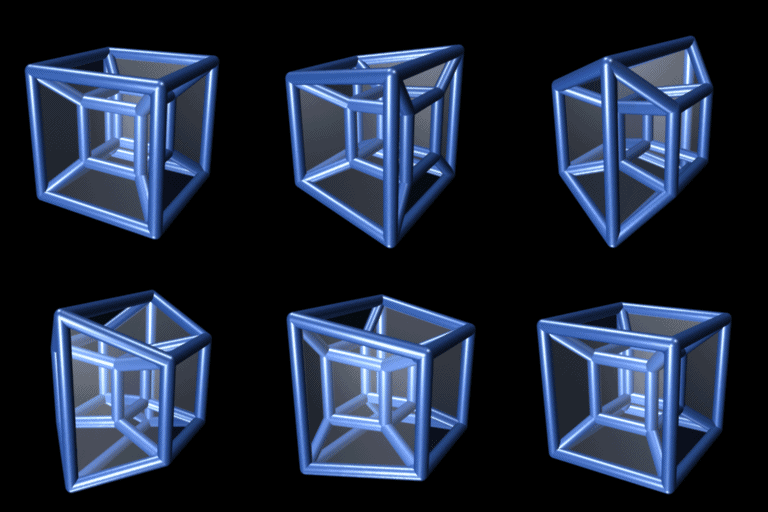
The 4th dimension space

4th dimensional space

In mathematics, four-dimensional space ("4D") is a geometric space with four dimensions. It typically is more specifically four-dimensional Euclidean space, generalizing the rules of three-dimensional Euclidean space. It has been studied by mathematicians and philosophers for over two centuries, both for its own interest and for the insights it offered into mathematics and related fields.
Algebraically, it is generated by applying the rules of vectors and coordinate geometry to a space with four dimensions. In particular a vector with four elements (a 4-tuple) can be used to represent a position in four-dimensional space. The space is a Euclidean space, so has a metric and norm, and so all directions are treated as the same: the additional dimension is indistinguishable from the other three.
In modern physics, space and time are unified in a four-dimensional Minkowski continuum called spacetime, whose metric treats the time dimension differently from the three spatial dimensions (see below for the definition of the Minkowski metric/pairing). Spacetime is not a Euclidean space.
Lagrange wrote in his Mécanique analytique (published 1788, based on work done around 1755) that mechanics can be viewed as operating in a four-dimensional space — three of dimensions of space, and one of time.[1] In 1827 Möbius realized that a fourth dimension would allow a three-dimensional form to be rotated onto its mirror-image,[2] and by 1853 Ludwig Schläfli had discovered many polytopes in higher dimensions, although his work was not published until after his death.[3] Higher dimensions were soon put on firm footing by Bernhard Riemann's 1854 Habilitationsschrift, Über die Hypothesen welche der Geometrie zu Grunde liegen, in which he considered a "point" to be any sequence of coordinates (x1, ..., xn). The possibility of geometry in higher dimensions, including four dimensions in particular, was thus established.
 Mathematically four-dimensional space is simply a space with four spatial dimensions, that is a space that needs four parameters to specify a point in it. For example, a general point might have position vector a, equal to
\mathbf{a} = \begin{pmatrix} a_1 \\ a_2 \\ a_3 \\ a_4 \end{pmatrix}.
This can be written in terms of the four standard basis vectors (e1, e2, e3, e4), given by
\mathbf{e}_1 = \begin{pmatrix} 1 \\ 0 \\ 0 \\ 0 \end{pmatrix}; \mathbf{e}_2 = \begin{pmatrix} 0 \\ 1 \\ 0 \\ 0 \end{pmatrix}; \mathbf{e}_3 = \begin{pmatrix} 0 \\ 0 \\ 1 \\ 0 \end{pmatrix}; \mathbf{e}_4 = \begin{pmatrix} 0 \\ 0 \\ 0 \\ 1 \end{pmatrix},
so the general vector a is
 \mathbf{a} = a_1\mathbf{e}_1 + a_2\mathbf{e}_2 + a_3\mathbf{e}_3 + a_4\mathbf{e}_4.
Vectors add, subtract and scale as in three dimensions.
The dot product of Euclidean three-dimensional space generalizes to four dimensions as
\mathbf{a} \cdot \mathbf{b} = a_1 b_1 + a_2 b_2 + a_3 b_3 + a_4 b_4.
It can be used to calculate the norm or length of a vector,
 \left| \mathbf{a} \right| = \sqrt{\mathbf{a} \cdot \mathbf{a} } = \sqrt{{a_1}^2 + {a_2}^2 + {a_3}^2 + {a_4}^2},
and calculate or define the angle between two vectors as
 \theta = \arccos{\frac{\mathbf{a} \cdot \mathbf{b}}{\left|\mathbf{a}\right| \left|\mathbf{b}\right|}}.
 \begin{align}
\mathbf{a} \wedge \mathbf{b} = (a_1b_2 - a_2b_1)\mathbf{e}_{12} + (a_1b_3 - a_3b_1)\mathbf{e}_{13} + (a_1b_4 - a_4b_1)\mathbf{e}_{14} + (a_2b_3 - a_3b_2)\mathbf{e}_{23} \\
+ (a_2b_4 - a_4b_2)\mathbf{e}_{24} + (a_3b_4 - a_4b_3)\mathbf{e}_{34}. \end{align}Minkowski spacetime is four-dimensional space with geometry defined by a nondegenerate pairing different from the dot product:
\mathbf{a} \cdot \mathbf{b} = a_1 b_1 + a_2 b_2 + a_3 b_3 - a_4 b_4.
As an example, the distance squared between the points (0,0,0,0) and (1,1,1,0) is 3 in both the Euclidean and Minkowskian 4-spaces, while the distance squared between (0,0,0,0) and (1,1,1,1) is 4 in Euclidean space and 2 in Minkowski space; increasing b_4 actually decreases the metric distance. This leads to many of the well known apparent "paradoxes" of relativity.
The cross product is not defined in four dimensions. Instead the exterior product is used for some applications, and is defined as follows:
This is bivector valued, with bivectors in four dimensions forming a six-dimensional linear space with basis (e12, e13, e14, e23, e24, e34). They can be used to generate rotations in four dimensions.

Extraterrestrial life

An unidentified flying object, or UFO, in its most general definition, is any apparent anomaly in the sky that is not identifiable as a known object or phenomenon. Culturally, UFOs are associated with claims of visitation by extraterrestrial life or government-related conspiracy theories, and have become popular subjects in fiction. While UFOs are often later identified, sometimes identification may not be possible owing to the usually low quality of evidence related to UFO sightings (generally anecdotal evidence and eyewitness accounts).
Stories of fantastical celestial apparitions have been told since antiquity, but the term "UFO" (or "UFOB") was officially created in 1953 by the United States Air Force (USAF) to serve as a catch-all for all such reports. In its initial definition, the USAF stated that a "UFOB" was "any airborne object which by performance, aerodynamic characteristics, or unusual features, does not conform to any presently known aircraft or missile type, or which cannot be positively identified as a familiar object." Accordingly, the term was initially restricted to those fraction of cases which remained unidentified after investigation, as the USAF was interested in potential national security reasons and/or "technical aspects" (see Air Force Regulation 200-2). During the late 1940s and through the 1950s, UFOs were often referred to popularly as "flying saucers" or "flying discs". The term UFO became more widespread during the 1950s, at first in technical literature, but later in popular use. UFOs garnered considerable interest during the Cold War, an era associated with a heightened concern for national security. Various studies have concluded that the phenomenon does not represent a threat to national security nor does it contain anything worthy of scientific pursuit (e.g., 1951 Flying Saucer Working Party, 1953 CIA Robertson Panel, USAF Project Blue Book, Condon Committee).
The Oxford English Dictionary defines a UFO as "An unidentified flying object; a 'flying saucer'." The first published book to use the word was authored by Donald E. Keyhoe.[1]
Studies have established that the majority of UFO observations are misidentified conventional objects or natural phenomena—most commonly aircraft, balloons, noctilucent clouds, nacreous clouds, or astronomical objects such as meteors or bright planets with a small percentage even being hoaxes.[note 1] Between 5% and 20% of reported sightings are not explained, and therefore can be classified as unidentified in the strictest sense. While proponents of the extraterrestrial hypothesis (ETH) suggest that these unexplained reports are of alien spacecraft, the null hypothesis cannot be excluded that these reports are simply other more prosaic phenomena that cannot be identified due to lack of complete information or due to the necessary subjectivity of the reports.
Photograph of an alleged UFO in New Jersey, taken on July 31, 1952

Friday, 1 May 2015

sun's surface

    
The sun's surface is blisteringly hot at 10,340 degrees Fahrenheit -- but its atmosphere is another 300 times hotter. This has led to an enduring mystery for those who study the sun: What heats the atmosphere to such extreme temperatures? Normally when you move away from a hot source the environment gets cooler, but some mechanism is clearly at work in the solar atmosphere, the corona, to bring the temperatures up so high.

Clear evidence now suggests that the heating mechanism depends on regular, but intermittent explosive bursts of heat, rather than on continuous gradual heating. 
This is the inaugural meeting for TESS, which is a first of its kind: uniting the various research groups that study the sun-Earth connection from explosions on the sun to their effects near our home planet and all the way out to the edges of the solar system – a research field collectively known as heliophysics. The overarching goal is to share techniques across disciplines and encourage interdisciplinary collaboration on outstanding heliophysics questions.
The coronal heating mystery is one such outstanding question. Four scientists spoke at the media briefing.
Jim Klimchuk, a solar scientist at NASA's Goddard Space Flight Center in Greenbelt, Maryland, explained that the new evidence supports a theory that the sun's corona is heated by tiny explosions called nanoflares. These are impulsive heating bursts that individually reach incredibly hot temperatures of some 10 million Kelvins or 18 million degrees Fahrenheit – even greater than the average temperature of the corona – and provide heat to the atmosphere. The research evidence presented by the panel spotted this super hot solar material, called plasma, representative of a nanoflare.

NASA’s MESSENGER Spacecraft Collides with Mercury

MESSENGER was launched on August 3, 2004, and it began orbiting Mercury on March 18, 2011.
The spacecraft completed its primary science objectives by March 2012. Because its initial discoveries raised important new questions and the payload remained healthy, the mission was extended twice, allowing the probe to make observations from low altitudes and capture images and information about the planet in unprecedented detail.
Last month, the MESSENGER team embarked on a hover campaign that allowed the spacecraft at its closest approach to operate within a narrow band of altitudes, 5 to 35 km above the planet’s surface.
On April 28, the team successfully executed the last of seven orbit-correction maneuvers (the last four of which were conducted entirely with helium pressurant after the remaining liquid hydrazine had been depleted).
With no way to increase its altitude, the probe was finally unable to resist the perturbations to its orbit by the Sun’s gravitational pull, and it crashed into the planet, creating a new crater up to 52 feet (15.8 m) wide.
“Today we bid a fond farewell to one of the most resilient and accomplished spacecraft ever to have explored our neighboring planets,” said Dr Sean Solomon of Columbia University’s Lamont-Doherty Earth Observatory, who is MESSENGER’s Principal Investigator.
This colorful view of Mercury was produced by using images from the color base map imaging campaign during MESSENGER’s primary mission. These colors are not what Mercury would look like to the human eye, but rather the colors enhance the chemical, mineralogical, and physical differences between the rocks that make up the planet’s surface. Image credit: NASA / Johns Hopkins University Applied Physics Laboratory / Carnegie Institution of Washington.

Speed of light

The speed of light in vacuum, commonly denoted c, is a universal physical constant important in many areas of physics. Its value is exactly 299792458792458 metres per second, as the length of the metre is defined from this constant and the international standard for time. According to special relativity, c is the maximum speed at which all matter and information in the universe can travel. It is the speed at which all massless particles and changes of the associated fields (including electromagnetic radiation such as light and gravitational waves) travel in vacuum. Such particles and waves travel at c regardless of the motion of the source or the inertial frame of reference of the observer. In the theory of relativity, c interrelates space and time, and also appears in the famous equation of mass–energy equivalence E = mc2.
Image result for Speed of light
The speed at which light propagates through transparent materials, such as glass or air, is less than c. The ratio between c and the speed v at which light travels in a material is called the refractive index n of the material (n = c / v). For example, for visible light the refractive index of glass is typically around 1.5, meaning that light in glass travels at c / 1.5 ≈ 200000 km/s; the refractive index of air for visible light is about 1.0003, so the speed of light in air is about 299700700 km/s or 90 km/s slower than c.
     Actually when you see an object it the space literally you are seeing the past of object. The time of the object depends on how far the object is and how much time the light from the object is. 
Eg: Sunlight takes about 8 minutes 17 seconds to travel the average distance from the surface of the Sun to the Earth. Then the sun you are seeing is literally 8mins and 17 sec in the past

The distance from the Sun to the Earth is shown as 150 million kilometers, an approximate average. Sizes to scale.
Sunlight takes about 8 minutes 17 seconds to travel the average distance from the surface of the Sun to the Earth.

Exact values
metres per second299792458
Planck length per Planck time
(i.e., Planck units)
1
Approximate values (to three significant digits)
kilometres per hour1080 million (1.08×10⁹)
miles per second186000
miles per hour671 million (6.71×10⁸)
astronomical units per day173[Note 1]
Approximate light signal travel times
DistanceTime
one foot1.0 ns
one metre3.3 ns
from geostationary orbit to Earth119 ms
the length of Earth's equator134 ms
from Moon to Earth1.3 s
from Sun to Earth (1 AU)8.3 min
one light year1.0 year
one parsec3.26 years
from nearest star to Sun (1.3 pc)4.2 years
from the nearest galaxy (the Canis Major Dwarf Galaxy) to Earth25000 years
across the Milky Way100000 years
from the Andromeda Galaxy to Earth2.5 million years
from Earth to the edge of the observable universe46.5 billion years

More of Io

         Jupiter's super volcanic moon Io is apparently responsible for dramatic brightening of the giant planet's stunning blue auroras, a new study suggests.
         Auroras are generated when electrically charged particles collide with a planet's atmosphere, where they excite gases and cause them to glow. The sun is the source of the particles that produce Earth's auroras, which are also known as the northern and southern lights.
      Jupiter's auroras, which are sparked by particles from the planet's moons as well as the sun, are thousands of times more energetic than Earth's and many times bigger than Earth itself. They're also constant, but every once in a while they grow to an incredible intensity — the result not of a solar flare but of volcanic activity on Io, according to the new study.                                                                                                                                                                
Blue Aurora on Jupiter
The blue aurora that is constantly glowing on the giant planet Jupiter.


Pluto

   Pluto was discovered by Clyde W. Tombaugh on February 18, 1930.Once found, Pluto's faintness and lack of a resolvable disc cast doubt on the idea that it was Lowell's Planet X. Estimates of Pluto's mass were revised downward throughout the 20th century.
          Image result for Clyde W. Tombaugh       Clyde Tombaugh, the astronomer who discovered Pluto.
     Images of  Clyde W. Tombaugh